Many businesses now employ sustainability roles, tasked with leading sustainability audits, identifying and reporting issues, galvanising stakeholder support, training colleagues, interpreting results for the wider industry, and more.
Moreover, the Institution of Engineering and Technology released a 2020 report finding that over two-thirds of children hoped to pursue a career that helps the environment.
But how do you start a career in sustainability? This guide will help you get on the right track.
What skills do I need to build a career in sustainability?
If you’re looking to retrain or build a career in sustainability, an excellent place to start is TSW Training’s range of ISEP courses, which will give you green skills, the knowledge and tools to create a sustainability plan, and the skills to analyse and report findings, as well as build stakeholder buy-in across your organisation.
There are also courses to help you stay abreast of changes in government legislation and respond accordingly.
What are green skills?
Green skills include the knowledge, values, attitudes and abilities needed to support a sustainable lifestyle or workplace within a circular economy.
Such skills are expected to gradually become integrated across a range of roles and industries, much as digital skills have become integrated into everyday work.
The main ‘hard’ green skills needed for a role such as a sustainability manager or similar level of career include:
- Environmental Science and Policy knowledge
- Environmental
- Health and Safety
- Auditing and Monitoring
- Finance
- Risk Analysis
Such a list of skills might imply that only a few highly technical candidates will be suitable for the role of sustainability manager; however, with various levels available, these do not need to put you off when starting.
Besides, you might already possess ‘softer’ skills which will help you start on your path to a career in sustainability, including:
- Management
- Communications
- Planning
- Customer Service
- Innovation
- Leadership
- Research
Everyone has their part to play in making our economy greener, and there are opportunities to reach your sustainability career goals.
What sustainability training is available?
There is a wide range of in-depth environmental training available to employees at junior and senior levels, with opportunities to earn an ISEP Foundation Certificate in Environmental Management, which leads to an ISEP Certification in Environmental Management.
With each of these course qualifications, you can also gain respective ISEP Associate membership and ISEP practitioner membership, whereby you’ll gain access to many career-building perks such as access to the networks, tutorials, webinars and much more.
As sustainability has become essential to business survival, forward-thinking companies may be willing to fund ISEP courses and support workers on their path to becoming fully qualified sustainability managers, equipped with the skills needed to help the business succeed.
If you’re fresh out of school and looking to build a career in sustainability, explore university degrees, internships and apprenticeships.
Other careers in sustainability
You’ll find thousands of sustainability-related jobs currently available. Roles such as sustainability manager are increasingly desirable in businesses worldwide as they work toward a greener economy.
But there are also more specific skills which are welcome in sustainability careers across various industries.
Science
The utilities sector is just one which requires skills and knowledge in fields such as physics and biology.
As the world adapts to the challenges of climate change, science-based skills are becoming increasingly important in the transition towards sustainable energy sources.
Engineering, manufacturing and design
Both technical and creative skills are needed to develop new products and solutions that meet net-zero targets and transform how we do business and lead our lives.
As businesses identify the issues that hinder net-zero achievement, they rely on developing new ideas and practices to streamline processes, reduce waste and emissions, and meet consumer demand.
Legal and managerial
Sustainability is not just about finding solutions to today’s and tomorrow’s challenges.
Changes in laws governing business activities and sustainability are expected to continue, as governments seek to meet their own targets for emissions and, ultimately, the global drive to limit temperature rise.
This is not only driving growth in careers in environmental law but also in related fields such as compliance, governance, and inspecting and monitoring activities to ensure businesses comply with legal standards and future-proof themselves against new challenges.
Here are some green-skills career opportunities that may be available to you.
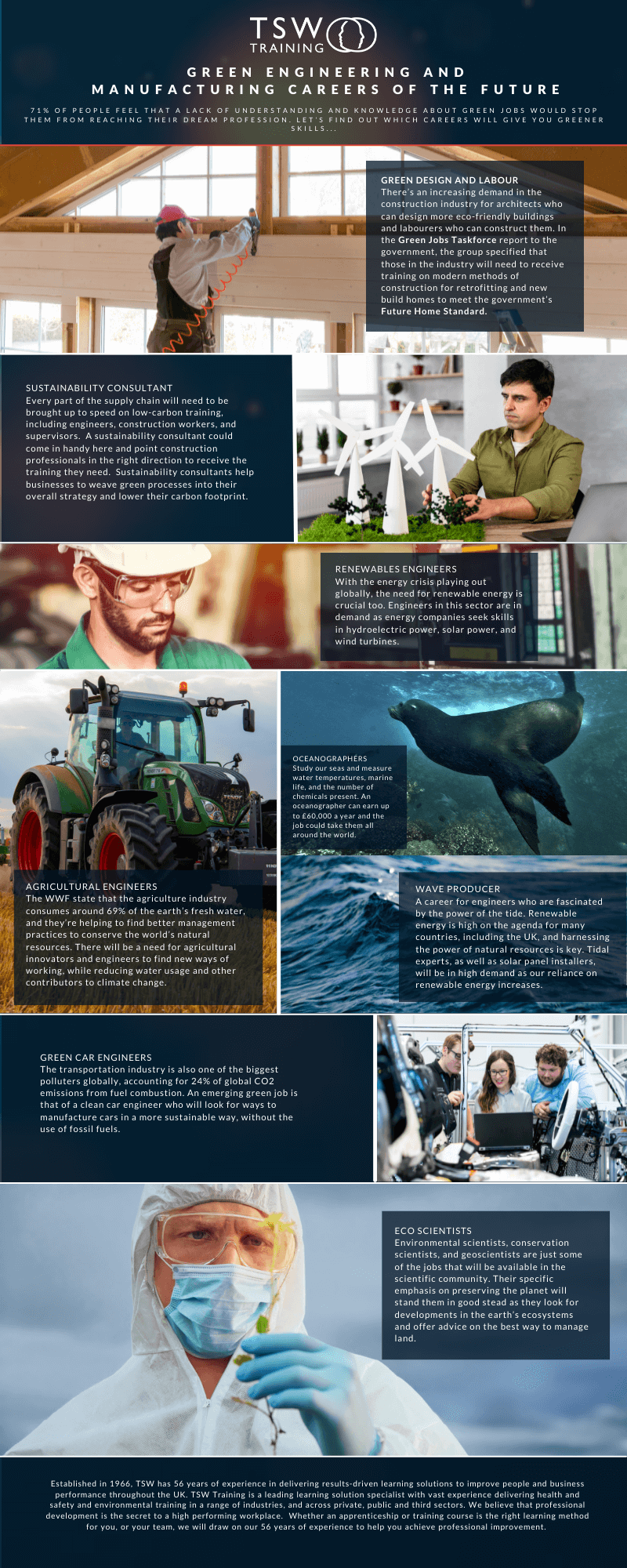
What about prospects, progression and salary?
Sustainability is here to stay, and the resulting industries and careers are expected to continue growing over time.
As with any career, salary expectations and career progression are dependent on the scarcity of skills and experience in that role or field. According to Glassdoor, the average salary in the UK for a sustainability manager is around £49,500.
By upskilling their green skills, those pursuing a career in sustainability will become much more attractive to prospective employers and more competitive with other candidates.
6 tips to start your career in sustainability
Breaking into the sustainability industry can be a challenging yet rewarding endeavour, especially given the forecasted explosion in opportunities. Here are some top tips to get started on your sustainability career path:
#1. Acquire Relevant Skills and Knowledge
Pursue an education or training program that provides the technical skills and knowledge required in the sustainability sector. An ISEP-accredited qualification, for example, can give you a competitive edge.
#2. Gain Practical Experience
Internships, volunteering, or part-time jobs in the field can provide valuable hands-on experience. They can also help you establish a network of professional contacts.
#3. Stay Informed
The field of sustainability is constantly evolving. Stay up to date on the latest trends, technologies, and policies.
#4. Network
Attend industry events, join professional organisations, and connect with professionals in the field. Networking can often lead to job opportunities.
#5. Demonstrate Passion and Commitment
Show potential employers that you are genuinely passionate about sustainability. This could be through personal projects, involvement in sustainability initiatives at school or in your community, or even through the way you live your life.
#6. Be Flexible and Adaptable
The sustainability sector is broad and diverse. Be open to opportunities that might fall outside of your initial area of interest. These opportunities could lead you down a fulfilling career path you hadn’t previously considered.