Imagine a workplace where everyone did what you needed them to do, without the need for micro-management and prodding. Even better, picture employees doing these things because they genuinely want to, not because they have to!
Motivation is arguably the most critical lever managers and leaders have for creating high performance.
By using Maslow’s Hierarchy of Needs to motivate your employees and fulfil their needs, you will likely see them make maximum contributions, often without needing to cajole them continually.
⏰TL;DR – How to Apply Maslow’s Hierarchy of Needs in the Workplace
- Good leaders and managers understand that to create high-performing individuals and teams, they must attune to the human motivations of their people.
- Maslow’s hierarchy of needs motivation theory is a go-to model that explains the psychology of human motivation.
- It will help you spend less time guessing what makes your people tick so that you can spend more time doing the things that motivate them.
What is Maslow’s Hierarchy of Needs?
In 1943, Abraham Maslow, a humanist psychologist, proposed a theory in his paper “A Theory of Human Motivation” that he called the Hierarchy of Needs. Maslow believed that all humans have needs that must be satisfied, ranging from the most basic to the most complex.
According to Maslow, people will be consumed by their basic needs before moving on to other, more advanced needs.
To better understand this principle, imagine that you haven’t eaten for three days; your dissatisfaction with this situation will likely provide you with great motivation to find food. At that moment, it is improbable that you’ll be motivated to do an excellent job at work and get recognition for doing so.
Maslow supported this idea by saying that “A person who is lacking food, safety, love, and esteem would most probably hunger for food more strongly than for anything else“.
In short, not meeting a physiological need will often monopolise a person’s thoughts, dwarfing any idea of fulfilling higher-level needs, such as esteem and recognition.
Once the core needs at a given level are satisfied, the next level in the hierarchy will emerge more strongly and become a driver of behaviours and thoughts. Maslow’s theory emphasises that a fulfilled need is no longer an active motivator; therefore, once a person has satisfied the requirement, they will seek to meet a higher-level need.
💡An example of Maslow’s Hierarchy of Needs
For example, many people will be motivated by an increase in their salary, until they actually receive that salary. Once the person has met that money need, it is less likely to be a constant motivator. In fact, you may now be motivated toward a higher salary or a different goal altogether.
Maslow’s Hierarchy of Needs Examples
Maslow himself uses the “person lacking food” analogy to describe his theory. But how does this transfer to a working environment?
Here are some ways you can use the four core areas of the theory to provide a nurturing space for employees to develop:
- Physiological needs: Provide a comfortable, safe and clean work environment.
- Love & belonging needs: Allow employees to feel like they belong to a team within your brand – social events and team building can help here.
- Esteem needs: Use ILM Courses for training your management team to recognise great employee performance.
- Self-actualisation: Support self-reflection in line managers and team leaders – 360 feedback can be a great way to achieve this.
What are the 5 Levels of Maslow’s Hierarchy of Needs?
Maslow presented us with the five basic human needs:
Maslow’s model presents the hierarchy of needs in a pyramid; here’s our adapted version:
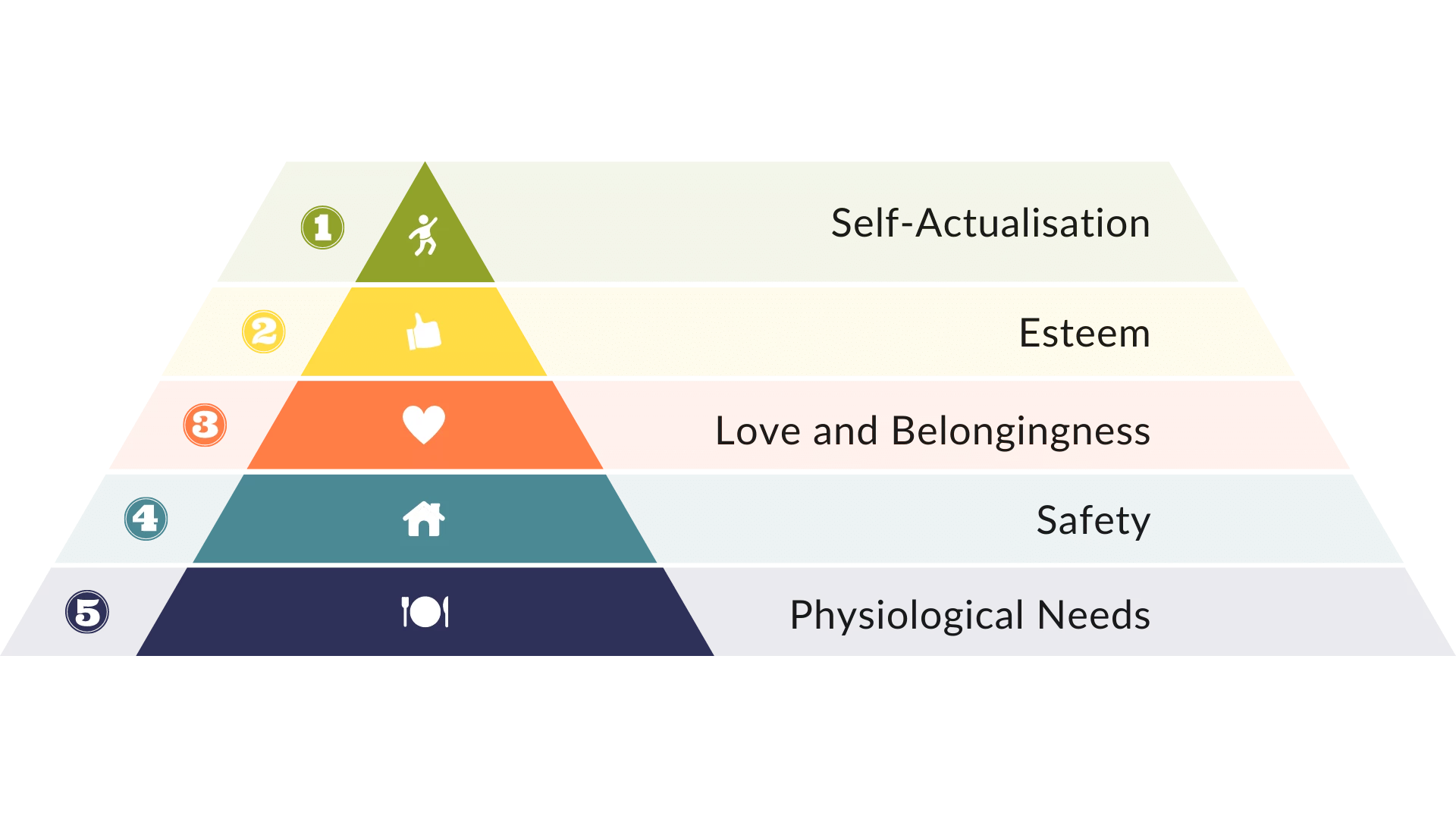
Maslow’s Hierarchy of Needs Diagram
Basic Needs (Level 1-2)
The first two levels of Maslow’s hierarchy encompass the basic requirements that are essential for human survival.
Maslow’s Hierarchy Level 1: Physiological Needs
Our basic physiological needs (aka physiological drives) ensure our survival. Some examples of physiological needs include:
- Food
- Water
- Shelter
- Warmth
- Sleep and rest
- Homeostasis (this is the body’s natural mechanism for maintaining a stable, constant environment)
These physiological needs are the most basic in Maslow’s hierarchy and provide people with a sense of security that they’ll survive another day. Once met, we move on to more advanced needs.
🏆What can managers do to motivate employees with physiological needs?🏆
- Provide employees with adequate food and water, or ensure they are aware of what they need to bring to work. The more you can provide, the better.
- Ensure that the workplace is well-heated or cooled to maintain the correct temperature and comfort levels.
- If your business requires work outdoors, be sure to provide your staff with clothing suitable for all weather conditions.
- Keep company cafeterias, kitchens, and vending machines stocked with a variety of healthy foods.
- Adequately maintain workspaces, especially where workers spend any length of time, such as desks and production lines. Ensure good air quality, complete DSE assessments and act to improve these spaces.
Maslow’s Hierarchy Level 2: Safety Needs
Once a person’s physiological needs are satisfied, the safety needs at level two of the hierarchy come into play. The safety needs are focused on ensuring we do not put ourselves in harm’s way and fulfil an innate desire for control and predictability in our lives. These safety needs include:
- Protection from the elements and danger (e.g., shelter, clothing, PPE)
- Peace of mind and freedom from fear
- Job security and/or a means of income
- Legal protection
- Financial safety (having a steady income to provide for oneself)
- Security against accident, sickness and injury both at work and at home
The most common needs people experience at this level include feeling safe within one’s own house or workspace, knowing their family is protected when they’re away from them, and financial security by having enough funds to afford basic necessities such as food and water. Once these needs are met, individuals will move onto more complex needs.
🏆What can managers do to motivate employees with safety needs?
- Provide a safe, secure work environment with clear guidelines and responsibilities and ensure that workplace security is appropriate.
- Ensure that employees know they can be there for their families without fear of judgment or adverse consequences; this may include family-friendly policies such as time off for emergencies, birthdays, and flexible working hours, among others.
- Managers should use strategies such as implementing new policies regarding safety and well-being, harassment, bullying and equal pay.
- Consider providing health insurance as part of employee packages.
- Ensure that all employees go through health and safety training courses and are empowered to proactively speak up when things aren’t as they should be.
- Ensure that they’re not overworking their staff, providing them with a fair living wage so they can support themselves and their families.
- Ensuring staff are paid on time so that they can manage their finances effectively.
Psychological Needs (Level 3-4)
These address emotional and social needs that help individuals feel valued and accepted within their social circles.
Maslow’s Hierarchy Level 3: Social Needs
When we have fulfilled our safety needs, we quickly become aware of a need to satisfy our social needs, including feeling close to others, interpersonal relationships, and belongingness. We often refer to this level as being about love and belonging. Specific social needs include:
- A need for friendship: our social psychology drives our desire to have close friends and people we can rely on
- A need to feel loved and accepted
- A sense of belonging: this is one of our most important psychological needs, which we can fulfil by being part of groups and clubs or having friendships with people who share similar interests.
- A sense of love or affection refers to the feeling of being loved or cherished by others.
- A need for family connection: A feeling that one belongs in a family unit is often significant and closely linked to a sense of love.
- A need to be liked: Most people know this one; more often than not, a person desires to be liked and to be looked upon in a positive light
Isolation, anxiety, and depression are all undesirable states for a person, and this is where social needs are so important. When these needs are denied, it can be easy for a person to experience a deterioration in their psychological well-being.
🏆What can managers do to motivate employees with social needs?
- Plan and organise activities that involve employees at work or outside the office. Exercises can be as simple as going out to lunch with coworkers, having coffee together after work, or taking a lunchtime walk and talk.
- Conduct team-building exercises both in and out of work, where individuals are encouraged to bond through social activities such as outings and games.
- Involve your employees’ families in work events and strive to foster a sense of community within the business.
- Have a company newsletter that shares information and helps build a sense of community. A newsletter is an easy way to disseminate motivational information, even across multiple sites, and provide a sense of direction for staff.
As leaders, we rarely speak of love in business, and I think we’re getting it wrong! Maslow said that:
“We must understand love; we must be able to teach it, to create it, to predict it, or else the world is lost to hostility and to suspicion.” Abraham Maslow
There’s a great book on leadership and love by Steve Farber. In his book “love is just damn good business“, he tells us that if we can make love an integral part of business culture, employees and customers start to feel genuinely valued.
It seems he agrees with Maslow; by attending to the need for love, you can foster employees who are more loyal, innovative, creative, and inspired, and that translates to a great customer experience.

Maslow’s Hierarchy Level 4: Esteem Needs
When we have fulfilled our social needs, we find ourselves seeking the fulfilment of esteem needs. A need for self-esteem refers to a person’s sense of self-worth and typically aligns with a person’s ability to live up to their expectations or standards in some regard.
Esteem needs include:
- A feeling of competence or mastery over one’s environment (e.g., a work project, a sporting achievement)
- A need for self-esteem: A person’s sense of self-worth is typically the result of one’s ability to live up to their own expectations or standards in some regard
- Recognition at work, at home or within society in general
- The desire to be necessary or significant among other people, such as by being considered an expert
- The need for autonomy and independence, meaning a willingness to act as oneself without being told how to behave
🏆What can managers do to motivate employees with esteem needs?
- Offer a challenging job with opportunities for advancement that align with the employee’s skills and abilities.
- Give employees responsibility for projects or tasks which build up their experience, skill base, and self-confidence.
- Don’t put employees in situations beyond their capabilities; the manager’s job is to build people up and support them by moving at a pace that is right for them.
These strategies are great ways to help deal with insecurities by providing an environment where people can feel competent while feeling they live up to your expectations and their own.

Self-fulfilment Needs (Level 5)
The final level focuses on personal growth and fulfilment that is driven by a sense of purpose.
Maslow’s Hierarchy Level 5: Self-actualisation Needs
Once the four levels of the Maslow hierarchy are fulfilled, and esteem needs are checked off, one can ascend to the pinnacle of Maslow’s motivation pyramid, where self-actualisation needs live.
Self-actualisation is the desire in human nature to fulfil our potential. Abraham Maslow defined it as “…the desire for self-fulfilment and to become more and more of what one is and everything that one is capable of becoming”.
Self-fulfilment is the desire to achieve personal growth needs and reach one’s full potential. Self-actualisation needs include:
- A need to be appreciated and recognised, meaning the desire for others to notice your accomplishments
- The need for creativity involves improving skills and generating new ideas or solutions.
- A need for personal growth, which is the drive to learn more about yourself, either by trying out something you never tried before or learning a skill that can improve your self-esteem.
Self-actualisation also includes becoming aware of one’s faults to work on them and improve. Managers can help by developing people to become more self-aware and accepting of their weaknesses.
Self-awareness of this nature is evident in all effective learning and development programmes, particularly leadership training courses, management training courses, and emotional intelligence courses.
Only when a person is aware of their strengths and weaknesses can they work on self-development.
Self-actualisation needs are typically only achieved by a minority of people, often because some skills (most often soft skills) are scarce. Typically, it is difficult for a person to become self-actualised if all other needs are not at least partially satisfied.
🏆What can managers do to motivate employees with self-actualisation needs?
- Offer opportunities for professional growth.
- Provide access to self-help books, articles and videos on topics relevant to the employees’ interests. You may consider a learning management system with a library of self-help content.
- Allow time off from work so they may attend classes or workshops required for their job.
- Strive to understand a person’s higher-level goals and give feedback on how well they are advancing toward self-actualisation (provide guidance when necessary but try to coach rather than tell)
- Help with difficult decisions by providing a sounding board where the individual can air their thoughts without judgment before making any final decision about what they should do next.
Maslow himself provided an important lesson when he said, “…the person’s intellectual integrity must be preserved…he cannot feel like his boss has taken control of him.” (Maslow)

Self-transcendence (Level 6)
Although Maslow’s Hierarchy often depicts five levels, there is a lesser-known sixth level which he deemed to be the true pinnacle of motivation. He referred to this higher-order need as ‘self-transcendence’.
The concept of self-transcendence represents the drive to move beyond the self and individual concerns. In doing so, you connect with something greater, such as spirituality, the greater good, or a higher purpose.
Self-transcendence involves a sense of unity, oneness, and interconnectedness with the universe, as well as the pursuit of meaning and values that extend beyond personal interests.
In the context of Maslow’s hierarchy, self-transcendence is considered a higher-order need that emerges once lower-order needs have been satisfied.
It represents a further stage of personal growth and self-discovery, where an individual seeks to understand their place in the world. In doing so, they cultivate a deeper connection with others, nature, and the universe as a whole.
⏰Key Point: It is important to note that Maslow’s hierarchy of needs is not a rigid or linear progression, and individuals may experience different needs simultaneously or move back and forth between levels.
However, the concept of self-transcendence illustrates that human development can extend beyond self-actualisation and into a broader, more interconnected experience of life.
Maslow’s 6th Level Hierarchy (Infographic)

Why is Maslow’s Hierarchy of Needs Important in the Workplace?
As a business owner, it’s incredibly important to provide your team with a working environment that is both stimulating and comfortable.
Following Maslow’s hierarchy of needs helps foster this atmosphere, but there are additional benefits to cultivating this environment.
- Workplace culture: Managing workplace culture is crucial to driving and maintaining a happy and sustainable business. Aiming at targets attached to the love & belonging elements of the theory will help foster this positive culture.
- Improved employee engagement: Enhancing the esteem of your workers by praising good performance fosters greater employee engagement.
- Enhanced productivity: Linked to engagement, research from Gallup indicates that businesses with engaged employees experience a 18% improvement in productivity compared to those with lower engagement levels.
- Reduction in absenteeism: Likewise, the same research found that businesses with more engaged/happier staff saw improvements in absenteeism of around 81%, proving that better, more connected, and holistic work environments foster healthier employees.
- Easier recruitment and retention: When you use Maslow’s approach to create a better working culture, you find recruiting and keeping talent in the brand easier. People want to be part of successful and improving companies.

How to Apply Maslow’s Hierarchy of Needs in the Workplace

Maslow’s hierarchy illustrates an individual’s inherent desire to be “self-actualised“, which is when they can use their talents and capacities to the fullest.
Your aim as a manager or leader should be to fulfil all the needs of your people, as this is the secret sauce for motivation and high performance.
⏰Key Point: Maslow explained that it isn’t essential to satisfy all needs at a given level before other higher-level needs emerge. You’d probably agree that it’s near impossible to fulfil all needs all of the time.
Maslow advises that the multitude of a person’s human needs are most often met, in part, simultaneously. Lower needs are generally the ones that people have satisfied the most.
To help employees satisfy esteem and self-actualisation needs, leaders and managers should endeavour to fulfil the most pressing needs at each level.
People are motivated by a desire to achieve or maintain the conditions that support the five needs.
Applying Maslow’s Hierarchy of Needs to business is not a complicated job. Instead, it’s a commitment to cultivate a cohesive work environment.
Ultimately, establishing strong workplace standards and connecting them to your employees’ safety, sense of belonging and self-esteem is the best way to implement this shift.
Once established, the safeguarding of this environment should be completed through your management team.
Applying the Hierarchy For Managers
However, reports on change management show that employees are more likely to embrace the shifts when there is buy-in from leaders.
For example, a person will go to great lengths to ensure they have water (or, if you’re like me, coffee :-)), as without it, the physiological need will go unfulfilled. In this particular example, withholding water will have serious consequences (not advised) and will undoubtedly hinder any ascent toward self-actualisation.
If you want to apply Maslow’s Hierarchy of Needs to motivate your team, understanding the hierarchy of needs can provide a structured framework that helps you do so.
A top tip for managers trying to create certain behaviours is that an act has more than one motivation. So, focusing on just one need as a lever isn’t your best strategy.

Best Practices to Implement Maslow’s Theory at Work
Here are the best practices for effectively integrating Maslow’s theory into your workplace to foster a thriving, motivated team.
#1. Understand Individual Needs
It’s essential when applying Maslow’s Hierarchy of Needs to consider the needs, goals and aspirations of each team member.
Organising regular one-to-one meetings, performance reviews, or informal meetings can help leaders learn more about these needs.
Only by taking the time to understand their team can leaders tailor their approach to meet those needs effectively.
#2. Prioritise Basic Needs
Meeting the basic needs of individual team members in the workplace should be the bare minimum for leaders and managers.
Ensure your staff have a comfortable work environment, adequate health and safety measures in place, competitive salaries and benefits.
#3. Foster a Positive and Inclusive Culture
A positive work environment that values open communication, collaboration, well-being and diversity can result in a team’s increased motivation and productivity.
Offering ample opportunities for collaborative work (such as teamwork) and social interaction (team building or social events), as well as being able to resolve conflicts swiftly and fairly, can all contribute to creating a positive culture. In turn, this leads to your team’s social needs being met, resulting in a more motivated and happy team.
Struggling to create this culture? Visit our blog on the 5 dysfunctions of a team to see where teams can fall down and what you can do about it.

#4. Provide Recognition and Feedback
To meet self-actualisation needs, it’s essential to regularly appreciate the achievements of your team and provide constructive feedback and praise for a job well done.
Rewards for good work can be provided, depending on the individual’s or team’s needs, such as bonuses, event tickets, vouchers, etc.
#5. Support Growth and Development
To support the self-esteem and self-actualisation needs of team members, leaders and managers could regularly provide opportunities for growth and development to enhance skills.
This could be achieved through training programmes, networking events, mentorship opportunities and more.
#6. Empower and Delegate
Giving staff members autonomy and control over their work can significantly increase motivation and self-esteem.
Delegating some of your important tasks to them can make your staff feel empowered and motivated.
#7. Communicate clearly
Effective communication is always key when leading a team.
Being transparent with your team about goals, aims, results, and organisational changes can help them feel involved, appreciated and valued by the company. Staff members will have greater trust and security in your team, resulting in increased motivation to perform well.
#8. Encourage Work-Life Balance
Encouraging a work-life balance is imperative for increased motivation.
Offering perks such as flexible working, regular breaks and increased holiday allowance are becoming the bare minimum for modern, grown-up companies.
Looking out for your staff’s well-being helps prevent burnout, stress and job turnover.

Example of Maslow’s Hierarchy of Needs in Action
In a manufacturing company, the team leader notices a decline in motivation among production line workers. Upon assessing the situation, the leader decides to address the motivation issue by considering Maslow’s Hierarchy of Needs.
Physiological Needs
The leader ensures that the production line workers have a safe and comfortable working environment. They provide proper safety equipment, well-maintained machinery, and regular maintenance checks to prevent any physical risks or hazards.
Additionally, they ensure that workers have access to clean bathrooms, break areas, and drinking water to meet their basic physiological needs.
Safety Needs
The leader focuses on addressing the safety concerns of the production line workers. They conduct regular safety training sessions to educate workers about best practices, potential hazards, and emergency procedures.
The leader also establishes a reporting system, such as RIDDOR 2013, where workers can report any safety issues or incidents, demonstrating their commitment to maintaining a safe work environment.
Social Needs
The leader encourages a positive team culture by fostering teamwork and collaboration. They organise regular team-building activities or events, such as group lunches or recreational outings, to promote a sense of togetherness among the production line workers.
Additionally, the leader establishes open communication channels, such as suggestion boxes or regular meetings, where workers can share their ideas, concerns, and suggestions.
Esteem Needs
The leader recognises the achievements and contributions of the production line workers. They implement a system to publicly acknowledge exceptional performance and provide regular feedback to help workers improve their skills.
The leader also offers opportunities for skill development and advancement within the manufacturing company, such as training programs or career growth paths, to enhance the workers’ self-esteem and sense of accomplishment.
Self-Actualisation Needs
The leader provides opportunities for self-actualisation by empowering the production line workers. They involve workers in process improvement initiatives, where they can contribute their ideas for optimising production processes or suggesting innovative solutions.
The leader also encourages cross-training and job rotation, enabling workers to acquire new skills and expand their knowledge across various areas of the manufacturing process.
By addressing the different levels of need, the team leader helps increase motivation among production line workers.
The workers feel valued, safe, and part of a supportive team, which enhances their job satisfaction and overall engagement. As a result, productivity and quality on the production line improve, leading to better business outcomes for the manufacturing company.
Impact of Growth and Deficiency Needs on Workplace Motivation
Maslow believed that deficiency needs (the first four levels), which provide the foundation of his hierarchy, play a significant role in motivating behaviours in human beings.
Physiological, safety, social, and esteem needs all arise from deficiency. That is to say, satisfying these lower-level needs is essential if we are to avoid unpleasant feelings or consequences.
In contrast, Maslow’s highest-level needs are referred to as growth needs. These emerge from a desire to grow and are not due to a deficiency or lack of something.
⏰Key point: If we fail to fulfil deficiency needs, at least partially, then the likelihood of becoming self-actualised is pretty slim; this is why managers should work through the hierarchy of needs, ensuring there are as few unfulfilled needs as possible.
- Taking steps to improve areas associated with deficiencies should be a priority in developing workplace motivation.
- When those enhancements have been completed, owners can then focus on ensuring personal development-focused goals to drive worker motivation.
- Regular one-to-one meetings with managers, clear career progression routes, and training opportunities to improve skills, such as ILM Level 3 Leadership and Management or ILM Level 5 Leadership and Management, can all be considered positive outcomes.

Challenges in Adapting Maslow’s Hierarchy in the Work Environment
However, it’s worth remembering that the Hierarchy of Needs approach is not a silver bullet to workplace harmony.
Although it is a celebrated theory, a recent article by Steve Denning for Forbes highlighted that the approach does face challenges. Some of these are:
- Employee buy-in: As renowned Psychologist Pamela Rudge states, “Here’s the problem with Maslow’s hierarchy. None of these needs, starting with basic survival on up, are possible without social connection and collaboration”. This is also true when applying the theory to business environments. For the approach to be practical, employees and management must buy in and collaborate.
- Budget: Details like team-building days or the creation of breakout spaces. Therefore, businesses need to assess whether their company budget allows for spending on items that improve motivation.
- Remote workers: Recent statistics indicate that 25% of the UK workforce continues to work from home. Hybrid workers may feel less included with in-office approaches and can struggle to feel a sense of belonging.
- Individual needs: Everyone’s needs are different, e.g. not every employee wants a ‘social’ work environment. Your management team needs to work with individuals on a 1-2-1 basis to create an approach that works for them.
- Ineffective communication: As we alluded to in the first point, the approach succeeds or fails based on the mutual sharing of information between managers and workers. Without collaboration, the hierarchy of needs cannot improve your approach.
Criticisms and Limitations of Maslow’s Hierarchy of Needs Theory
Maslow’s hierarchy of needs certainly has its critics. Here are some of the points of contention that are prevalent in critiques of the theory:
“Human needs don’t follow a strict hierarchy“
- While some studies have shown evidence of hierarchical needs, most research has not substantiated it.
- Wahba and Bridwell, in their ‘Maslow reconsidered’ paper, reviewed the swathe of studies testing Maslow’s theories. Their work culminated in them reporting a lack of evidence to support the ranking of needs and the existence of a hierarchy.
- While Maslow’s hierarchy is generally portrayed as following a rigid order, Abraham himself indicated that the ‘average order’ does not always follow. He said that “…it has been observed that an individual may permanently lose the higher wants in the hierarchy under special conditions“.
- Maslow explained that we should not see individual needs as sole determinants of specific behaviours; we should examine many behaviours as being motivated, in part, by each of the five needs, with some or all affecting the motivation in some way.
- You can find an example in the act of eating, invariably driven by multiple human needs and motivations. In this example, eating may come from the physiological need to fill your stomach. Simultaneously, the act may be motivated by a need to make things feel better or more comfortable.
- Also, the meal may be eaten with friends meeting the need for social connection. I know that the odd doughnut passes my lips with the multi-faceted needs of hunger and comfort eating after a bad day at the office! If I can do that with friends, then all the better.
- Motivation theories aren’t synonymous with behaviour theory
- When considering how to affect changes in behaviour, we can’t focus narrowly on just motivation theory; to do so would ignore biological, cultural and situational determinants. As a manager, you must consider each person and situation individually, considering both basic needs and broader personal preferences.

Frequently Asked Questions (FAQs)
Here are some frequently asked questions about Maslow’s Hierarchy of Needs in the workplace.
Can Leadership Development Programs Address the Needs of Employees?
Recognising the needs of employees should be a massive part of leadership development.
Including Maslow’s Hierarchy of Needs in our TSW management development helps showcase what is important to staff in a simple and actionable way.
Ensuring that your management team has the foresight and understanding to implement this approach, business-wide and on an individual targeting basis can make all the difference to performance.
How Can Organisations Identify Which Level of Maslow’s Hierarchy Needs More Attention in Their Workplace?
Speaking to workers is the best way to understand what level of the Hierarchy is most essential or lacking for them.
Performance statistics will show part of the picture, but it’s essential to delve deeper into your organisation to identify where stress lies.
The hierarchy can be implemented industry-wide, but is best leveraged as part of individual progression plans.
What Are the Signs That an Organisation Needs to Reassess Its Approach to Maslow’s Hierarchy?
There can be several signals that your business needs to pivot internal procedures to accommodate Maslow’s Hierarchy.
Some of these could be:
- Increased employee absenteeism
- Lack of internal progression
- Reduction in productivity
- High staff turnover
- Stagnating profits
- Low staff morale
- Overworked staff
As a business owner, your management team are the connection between you and your employees. Listen to their feedback to watch for these signals.
However, your management team is also part of the business. As such, they need ample opportunities to progress and the ability to develop the skills necessary to implement Maslow’s Hierarchy on a more individual basis.
ILM Courses with TSW Training are ideal for fostering these improvements within your team.
How Can Managers Ensure That They Are Meeting Employees’ Needs in a Remote Work Environment?
28% of the global workforce now operates remotely. With this in mind, business owners must also learn how to motivate their teams remotely.
There are several ways leaders can ensure they meet the needs of remote workers:
- Ensure pay remains fair
- Establish regular catch-ups
- Implement clear staff expectations
- Set performance-related SMART objectives
- Share advice on remote setups and useful software
- Schedule regular virtual team-building opportunities
- Ask for honest feedback on areas for improvement from remote staff
- Provide the right tools for the job – from technology to company credit cards and purpose-built policies & procedures
Conclusion
In the Hierarchy, Abraham Maslow has provided a valuable tool for grounding our management of people according to their innate human needs.
Leaders and managers can utilise the hierarchy of needs in strategic and operational planning to foster a positive work environment and enhance employee motivation.
But, Maslow’s hierarchy of needs isn’t the only motivation theory in town; other psychologists and practitioners have served up their own motivation theories, which include:
- Herzberg’s two-factor theory posits that two factors influence job satisfaction: intrinsic factors (the nature of the work itself) and extrinsic factors (such as pay, status, and working conditions).
- Vroom’s Expectancy theory suggests that behaviours result from conscious choices made to minimise pain or maximise pleasure. The more confident someone is in the outcome, the higher the motivation is likely to be.
- Robert House’s Path-Goal theory tells us that the primary role of a leader and manager is to motivate people. They do this by clarifying goals and providing a path to achieving them. They must also clearly communicate to employees the rewards for achieving these goals.
- Adams’ Equity theory – explains that people want to balance what they are getting with what they feel others are getting. For example, if you have a higher salary than someone else and the other person is doing more work, the other person will feel less motivated.