Using a SWOT analysis to help define your business’ strengths, weaknesses, threats, and opportunities is a great starting point for a successful strategy.
But beyond the facts, how do you know what your next step should be?
Bringing the TOWS matrix into the picture can help you take what you’ve learned and put it into practice.
Key Points:
- The TOWS matrix is a tool you can use alongside your SWOT analysis to identify areas of improvement within your business. It can help you put the findings from your SWOT analysis into action.
- TOWS differs from SWOT as it gives you the basis of a strategy you can use to identify what needs to change.
- The TOWS matrix can be applied to help boost business and team performance.
Ready to put these into action? Our management training courses will equip you with practical skills to manage confidently, turning challenges into opportunities. Enrol today to enhance your impact!
How does TOWS differ from SWOT?
A SWOT analysis and TOWS matrix utilise the same four factors (Strengths, Weaknesses, Opportunities, and Threats), but they’re applied at different stages of thinking.
In short, SWOT is primarily a diagnostic list of internal (S/W) and external (O/T) factors. TOWS is a strategy matrix that uses those factors to generate concrete options.
SWOT = situation scan
You identify and (ideally) prioritise internal strengths/weaknesses and external opportunities/threats. It’s descriptive, but it can inform action.
Typically, the SWOT analysis is used to gain a better understanding of the current landscape or situation.
TOWS = strategy builder
It takes the SWOT inputs and forces explicit pairings to create options. For example:
- SO strategies: Use strengths to seize opportunities.
- ST strategies: Use strengths to mitigate identified threats.
- WO strategies: Use opportunities to overcome your weaknesses.
- WT strategies: Minimise your weaknesses to avoid threats.
The TOWS matrix is typically run to generate and compare concrete strategies.
TOWS vs SWOT: Key differences
#1 – Starting point (the big one):
SWOT usually starts inside-out: list Strengths/Weaknesses first, then Opportunities/Threats.
TOWS goes outside-in: examine Threats/Opportunities first, then match to Weaknesses/Strengths. This reduces “we’re good at X, so let’s do X” bias and focuses you on the market/context before your capabilities.
#2 – Structure:
SWOT: four buckets of factors (often just a prioritised inventory).
TOWS: a 2×2 strategy matrix that forces pairings
#3 – Output:
SWOT – insights and priorities.
TOWS – a shortlist of actionable strategic moves (who/what/where to focus).
#4 – Stage in the process:
SWOT = situation analysis.
TOWS = strategy formulation (immediately after SWOT).
How can TOWS be applied in a workplace setting?
Any business can use the TOWS matrix to develop and test strategies that address its current and desired situations.
TOWS Matrix Diagram
The TOWS matrix below shows the pairings that can be used.
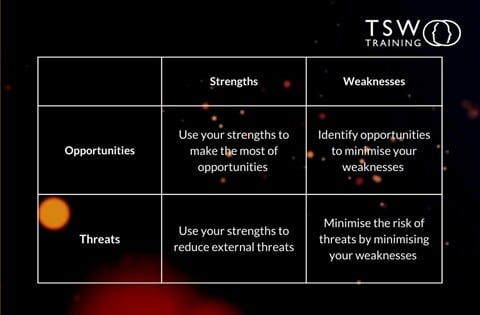
A TOWS Matrix Workplace Example (Lawnmower Company)
Here’s a quick, realistic example to illustrate how a SWOT analysis is transformed using the TOWS matrix.
Imagine a mid-sized lawnmower brand being squeezed by low-cost private labels as demand shifts toward battery-powered and robotic models. We’ll analyse the situation using a SWOT analysis, then utilise a TOWS matrix to convert those findings into four concrete strategy options (SO, ST, WO, WT).
From SWOT you have:
- S: Trusted for durability; strong dealer/service network; 48-hour parts availability.
- W: Thin battery-electric range; dated e-commerce (no financing/configurator); high unit costs.
- O: Fast growth in battery & robotic mowers; local grants for low-noise/low-emission kit; upsell of accessories & service plans online.
- T: Big-box private labels undercut on price; battery supply volatility; drought/noise rules reducing mow frequency and petrol appeal.
We use TOWS to turn that into strategic options:
SO – Use strengths to seize opportunities
- Launch a dealer-installed robotic mower program with bundled service plans.
- Target councils/landscapers with grant-backed battery models, leveraging brand durability + dealer service.
WO – Use opportunities to overcome weaknesses
- Partner/OEM a battery platform to fill the lineup quickly; prioritise top-selling walk-behinds and a pro rider.
- Overhaul e-commerce (financing, trade-in flow, accessory bundles) to capture online demand.
ST – Use strengths to counter threats
- Compete with private labels on total cost of ownership: durability + 48-hour parts + dealer support.
- Create a “Keep Cutting” inventory program for critical components to buffer supply shocks.
WT – Minimise weaknesses to avoid threats
- Rationalise low-margin petrol SKUs most exposed to price wars and regulation.
- Dual-source battery cells and introduce retrofit safety/noise kits to stay ahead of rule changes.
Carrying out this TOWS matrix has provided this manufacturing company with a solid foundation for a strategy that can help it build and grow over the next year or so.
How can leaders and managers use it to boost performance?
The TOWS matrix can be applied to your business, a new product launch, or even a team’s performance.
By examining the collective strengths and identifying weaknesses of the group, as well as assessing opportunities within the industry and potential threats from competitors, you can gain a deeper understanding of where your workforce needs to focus its attention.
For instance, a Head of Marketing who uses the TOWS matrix can identify that they need to develop more design skills within their team to enhance the visual appeal of their marketing materials and gain a competitive edge for the business.
That could mean training existing staff in design tools, or ensuring they can recruit new staff with these skills.
What are the advantages of using the TOWS matrix?
There are a few advantages of using the TOWS matrix:
- It gives you a clear, visual idea of the foundations of your strategy
- It’s easy to use across any industry, team, or individual
- It assesses internal elements, as well as external
- It helps you to take action from your SWOT analysis
What are the disadvantages of using the TOWS matrix?
- You still need to build out a detailed strategy from your TOWS matrix
- It doesn’t offer any help in terms of priorities
- You need to be aware of all strengths, weaknesses, opportunities, and threats to make good decisions
- It may need input from lots of individuals to make it work